
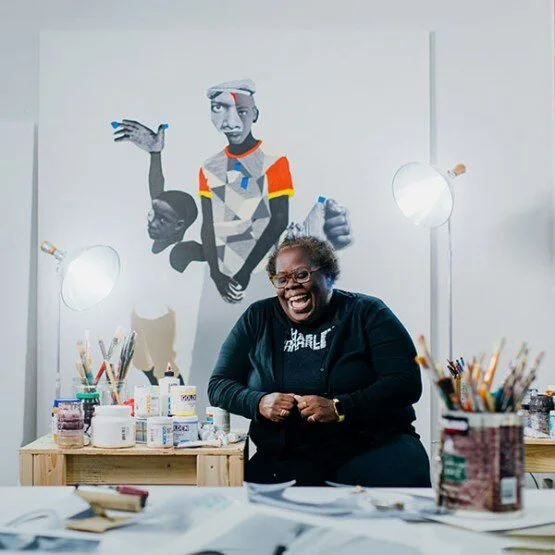
On Navigating The Art World And Visual Activism: Deborah Roberts
On December 2, we hosted artist Deborah Roberts at the BBATX Headquarters for an inspirational conversation with Rosa Rebellion founder and activist Virginia Cumberbatch.
A few weeks ago, BBATX (#bossbabesATX) and creative entrepreneur and visual artist, Mercy Emelike, continued with the second installment of CHATROOM, an art discussion series centered around Black women and non-binary artists in the Austin area.
On December 2, we hosted artist Deborah Roberts at the BBATX Headquarters for an inspirational with Rosa Rebellion founder and activist Virginia Cumberbatch.

Image courtesy of Deborah Roberts
ABOUT THE ARTIST, DEBORAH ROBERTS:
Deborah Roberts is a mixed media artist and Austin native and local who received her MFA from Syracuse University in New York. Her artistry aims to critique the notions of body, race, beauty, and identity in present-day society through the perspective of African-American children. Her work is presented on paper or canvas, and consist of materials from literature, photographs, magazines, and the internet, along with hand painted, intricate details that allow the viewer to gain a deeper outlook on the different layers. She focuses on African-American children, and how American racism plays a significant role in conditioning their experience growing up in the United States, as well as how they are perceived by others.

Image courtesy of Virginia Cumberbatch
ABOUT THE FACILITATOR, VIRGINIA CUMBERBATCH:
Virginia Cumberbatch is a director for the Community Engagement Center, a part of The University of Texas at Austin (UT) Division of Diversity and Communication Engagement (DDCE). She has used both her academic and professional years to facilitate discussions about diversity, inclusion, and equity in the Austin area. For her current work, Virginia ensures that the center continues to develop new and sustain mutually beneficial partnerships between the University of Texas and diverse communities, improving systems to be more accessible and equitable for historically underserved communities.
HERE ARE THREE TAKEAWAYS FROM THEIR DISCUSSION:
ON EMBRACING DIFFERENCES
Of the many topics discussed, Roberts touched on the importance of representation when sharing details about the subjects of her artwork. In the United States, there is a specific generalization of African-American characteristics and physical appearance that is constantly shown in the media. Roberts explains that “the people that [she] was creating and drawing were not the same people that were being projected into the world, because they had a different idea of Blackness that [she] could not see.” Everyone’s Black experience is not the same, and it was important to Roberts that she captured her own version to “dismantle the idea that [African Americans] are all grotesque, and also the idea that [they] all act the same.”
ON BREAKING THROUGH IN THE ART WORLD
Emerging into the art world can be extremely difficult for Black artists. Robert states that “whoever can get attention without an MFA, without education, is not Black. Black artists can do the work for years, but if they don’t have scholarship, no one will listen.” Every artist aims to have their stories shared and understood by many, but without the art world’s attention, they will struggle. There are many artists showcasing their ideal image of Blackness through visual storytelling, but if the story isn’t being told in a way that the art world will care for, then it will be overlooked.
The art world is constantly shifting its focus to new themes and ideas, and it’s important for artists to stay with the times if they want to continue to be relevant in this particular society. “The people who are going to survive are the ones who are working really hard, and that’s why it’s important to be in museum collections.” Robert also noted that “[she] was in school when [the art world] shifted to Black art” and that she thinks it has started to move “toward African art.”
ON ACTIVISM AND COMMUNITY-BUILDING
As Cumberbatch noted, art and activism are often intertwined because they both require imagination. When asked if she considers herself an activist, Roberts expressed that “artists have to be artists, and you can’t ask [them] to be more political in their work.” Being able to create art that isn’t aiming for a social change is a privilege, but it’s a privilege that Roberts can not relate to, because “[she] is in the school where you have to stand up for yourself, and if you don’t, no one will.” The disappearance of Black women is often overlooked and disregarded in our society, so making artwork that focuses on Black women who go missing is Roberts’ personal form of activism.
Roberts also admits that she is currently not that involved in community-building like she was in the past. She spent her “twenties and thirties changing the way people look at Black artists in Austin,” and she now wants to channel that energy into a different direction. It’s a personal goal of hers to create a foundation where she can give money to the artists who want to do this work.
WANT TO ATTEND THE LAST CHATROOM SESSION?
Join us at our next discussion on December 14, featuring painter, Arielle Austin, interviewed by artist and educator, Tammie Rubin.
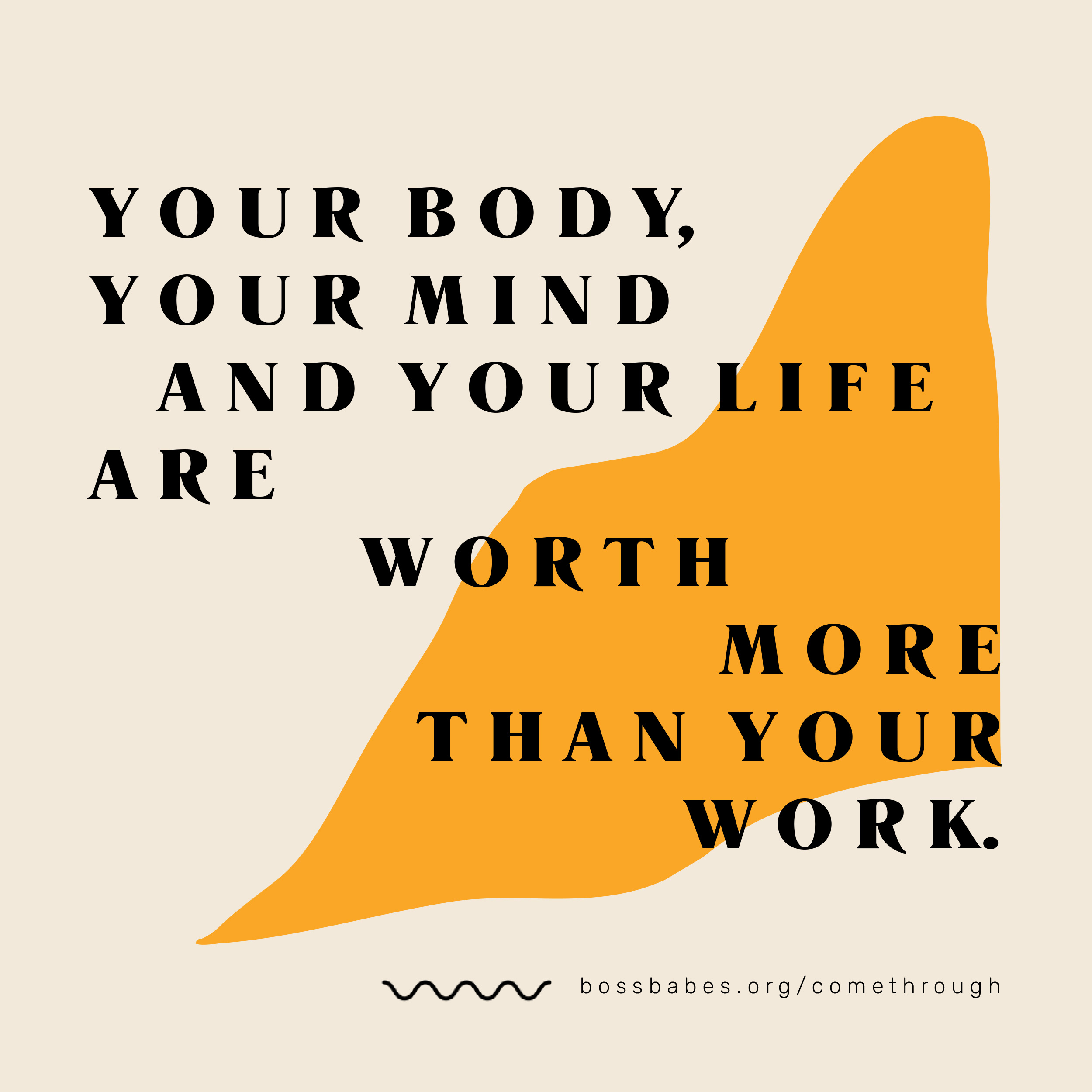
Three Reminders For Creative Revitalization In 2020
Throughout Winter 2020, our programs will amplify women and nonbinary creatives, business owners and leaders who are resetting their approaches to stress and success. As you move through our events from December to February to hear their stories, we encourage you to keep the following reminders in mind.
revitalize (v.): to imbue something with new life and vitality.
At work and in our lives, we all face seasons of renewal and restoration—and in turn, we all have moments that redefine who we are and where we want to go.
Whether we’re facing changes in our career paths, pushing ourselves out of a rut or revisiting old projects, adjusting to life’s pivots can be equal parts difficult and rewarding. So, what do we do when we recognize we need a change? How can we breathe new life into our work? What does it look like to revitalize our perspectives, mindsets and approaches to work, collaboration and creativity?
Throughout Winter 2020, our programs will amplify women and nonbinary creatives, business owners and leaders who are resetting their approaches to stress and success. As you move through our events from December to February to hear their stories, we encourage you to keep the following reminders in mind.
This post has been written by BBATX Founding Executive and Creative Director, Jane Hervey.
REMINDER NO. 1: YOUR FUTURE IS NOT DETERMINED BY THE LIMITED SCOPE OF OTHER PEOPLE’S OPINIONS.
We sometimes reject trying something new or giving up things that no longer serve us, because we’re worried about what others may think. You don’t need permission from your past self or your peers to experiment, fail or succeed.


REMINDER NO. 2: IF IT FEELS BAD, LISTEN. TUNING INTO YOUR EMOTIONS TRAINS YOUR INTUITION.
When we do something we’ve never done before, we’re outside of our circle of competence, which means we’ve stepped into a space of uncertainty. Uncertainty is exciting, but it can bring about a whole range of emotions, too. Sometimes, it’s enough to shut us down. So, get familiar with your feelings as you break old habits and give new methods and routines a shot. What’s anxiety? What’s fear? What’s your intuition?
REMINDER NO. 3: YOUR BODY, YOUR MIND AND YOUR LIFE ARE WORTH MORE THAN YOUR WORK.
A fresh start might be intimidating, but it gives us the chance to do things differently. You know more than you did last year. So, what can you change about your approach to stress and success? What can you rewrite or reset when it comes to your personal and professional goals? It’s always OK to begin again.

CURIOUS ABOUT OUR PROGRAMS AND THIS THEME?
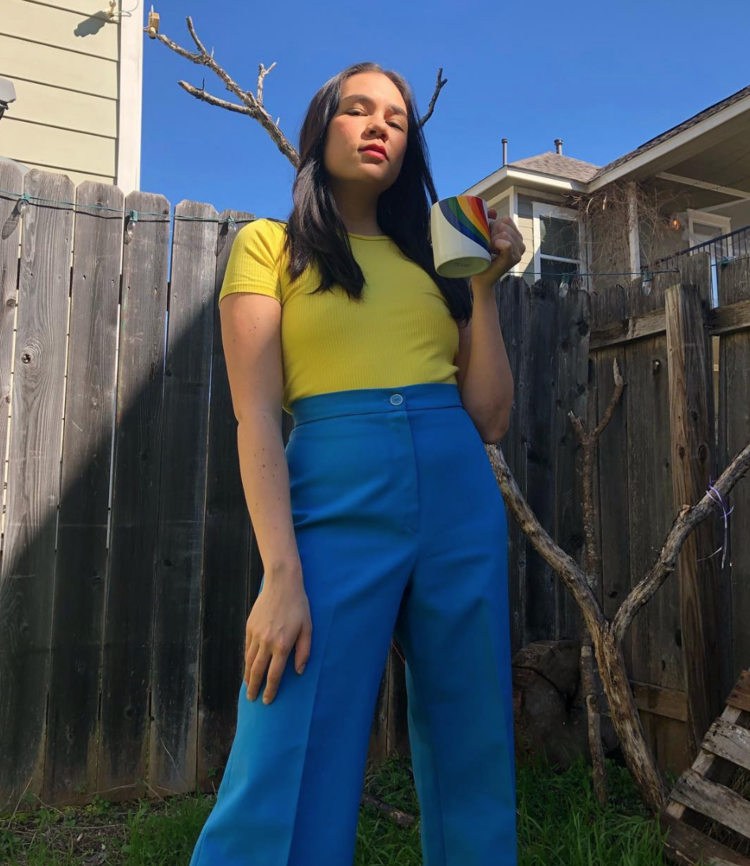
On Experimentation And Making Space For Your Ideas: Emily Ng
Emily Ng chats with us about her award-winning stick-and-poke shop, newly opened in East Austin.
This week, we’re preparing for the second conversation in our Money Mindsets series, a three-part conversation with local Austin leaders at the Capital One Café downtown on November 21, December 7 and December 19 exploring money setbacks, leveling up and staying financially informed.
Today, we’re publishing an interview with Emily Ng about her award-winning stick-and-poke shop, newly opened in East Austin.

ABOUT EMILY NG:
Emily Ng is a tattoo artist, musician and the owner of No Good Tattoo, a female-driven contemporary studio in Springdale General.
Describe the way your business and projects have grown and/or changed within the last three to five years.
No Good Tattoo has only been open for about six months, but a lot has changed since I decided to open the studio. It was originally going to be a private studio with just one other artist and I. The studio now hosts six full time artists and a constant stream of guests from around the US. This decision was based on the needs and wants I was constantly observing from my community. It was clear to me that there was a demand for more variety in the tattooing scene in Austin. It was also clear that many women, LGBTQ+ and non-binary folx and people of color were not being given chances to work in traditional shops. The decision to grow took all that into account. I started with three artists, including myself, and we have hired three more since. The shop is now full for the most part, and after putting some finishing touches on it early next year, I'll be working on opening a second location.
What's a money tip or trick that you've learned recently?
Don't fall trap to the "if you build it, they will come" mindset. Make sure people want to buy what you're selling before investing a lot of your own money or going into debt! You can do this by doing preorders or making an "MVP" (minimum viable product) that gives just enough of what you're trying to sell. If you can get a lot of people to commit to that, then you can feel confident making bigger financial investments.
What advice or lesson would you share with someone who’s at the start of doing their own thing?
Don't let yourself become paralyzed by big decisions. If you're waiting on someone more experienced to give you an answer, it might never happen. Do the research and then just go for it! Nothing is final; you can always change it later.

Design by Danni Wright
want more?
Join us at Money Moves and Mindsets this Saturday, December 7 from 10 AM to noon at the Capital One Café to hear Ng’s story. Thanks to Capital One’s commitment to supporting women in entrepreneurship and small business owners, this event is free and open to the public with RSVP.
Can’t make it? We highly suggest learning more about our biannual conference WORK, a one-day event that presents new ideas and approaches to creative and entrepreneurial work. Hosting 300 guests every summer and winter, this biannual, one-day event's panels, workshops and speaker sessions touch on personal and professional development, marketing, wellness, business management and entrepreneurship. ✨The next WORK conference will be held in January 2020 at the University of Texas at Austin’s Rowling Hall.
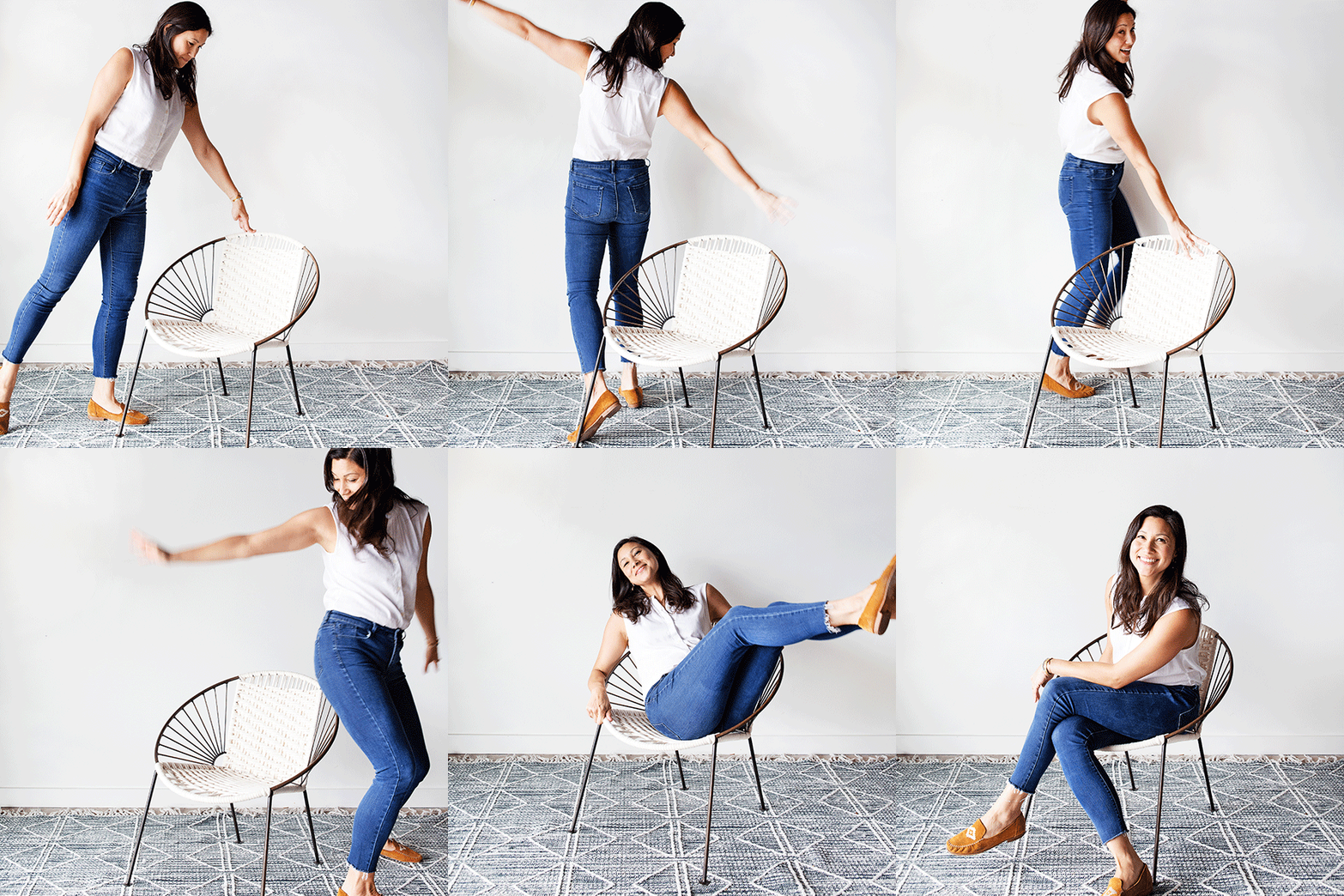
On Letting Your Business Grow and Evolve: Christie Zangrilli
Today, we’re publishing an interview with Christie Zangrilli about the growth and expansion of a business she co-founded three years ago, Party at the Moontower Rentals.
This week, we’re preparing for the second conversation in our Money Mindsets series, a three-part conversation with local Austin leaders at the Capital One Café downtown on November 21, December 7 and December 19 exploring money setbacks, leveling up and staying financially informed.
Today, we’re publishing an interview with Christie Zangrilli about the growth and expansion of a business she co-founded three years ago, Party at the Moontower Rentals.
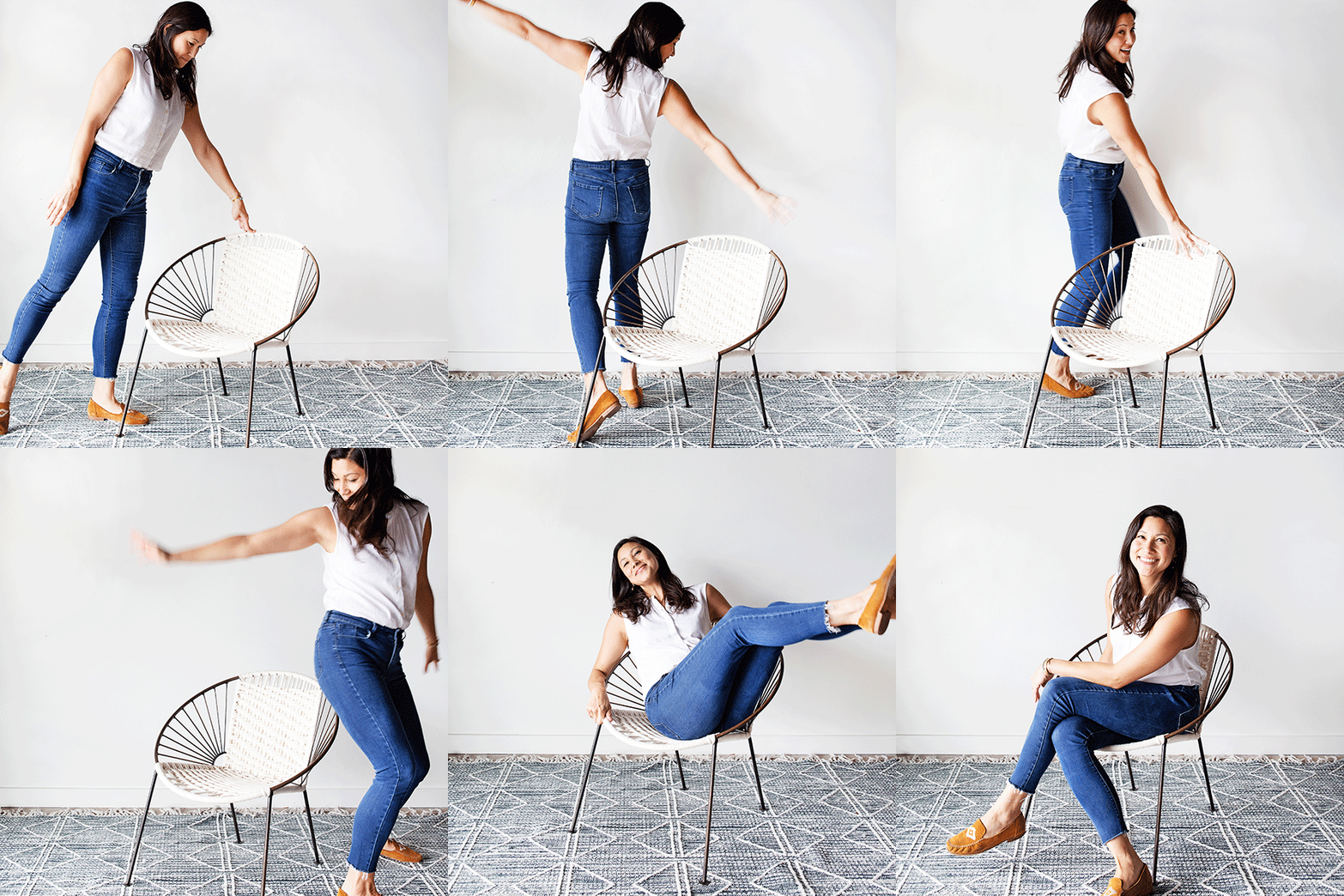
GIF by Heather Gallagher Photography
ABOUT CHRISTIE ZANGRILLI:
Christie is the co-owner of Party at the Moontower Event Rentals. She’s a brand-builder, pattern-lover, can-doer, child-wrangling type geek who likes to party.
Describe the way your business and projects have grown and/or changed within the last three to five years.
My current business is only three years old, so it has been all growth! When you first launch—because your business is all you’ve been thinking about—you expect people to start buying from you immediately. But it takes people a while to discover you and then be willing or have the opportunity to give you a try. It was almost a year before we saw any real traction. We’ve also seen an evolution in the type of clients we serve. Initially we expected 50/50 wedding and corporate clients, but now it’s clear that we corporate clients are our bread and butter. The reason, which is obvious looking back, is because our Austin-modern style much better fits corporate events versus romantic weddings.
What's a money tip or trick that you've learned recently?
Make an appointment with your CPA at the end of each quarter and have them build out a "progressive budget” and cash flow. The progressive budget looks at your budget versus actuals for that quarter (or if you don’t have prior history, then just look at what what you made/spent that quarter—this will then be the basis for your budget in the future). The cash flow will tell you the other stuff you spent on and should match up with your bank account. Based off this info you can easily see into the future and answer a lot of the questions we all struggle with. Send these questions to your CPA ahead of your meeting as well. For example:
How much can I afford to spend on additional inventory?
Does it look like I can afford to hire another person on within the next X months and if so, how much can I afford to pay?
What advice or lesson would you share with someone who’s at the start of doing their own thing?
Be somewhat prepared but don’t worry about knowing everything or having all the answers. There’s a point where you simply have to jump and figure it out on the way down.
Designed by Danni Wright
want more?
Join us at Money Moves and Mindsets this Saturday, December 7 from 10 AM to noon at the Capital One Café to hear Zangrilli’s story. Thanks to Capital One’s commitment to supporting women in entrepreneurship and small business owners, this event is free and open to the public with RSVP.
Can’t make it? We highly suggest learning more about our biannual conference WORK, a one-day event that presents new ideas and approaches to creative and entrepreneurial work. Hosting 300 guests every summer and winter, this biannual, one-day event's panels, workshops and speaker sessions touch on personal and professional development, marketing, wellness, business management and entrepreneurship. ✨The next WORK conference will be held in January 2020 at the University of Texas at Austin’s Rowling Hall.
On Investing In Yourself: A Conversation With Shauntavia Ward
In this Q&A, first-time entrepreneur and eleMINT Skin founder Shauntavia Ward reminds us to invest in ourselves.
This week, we’re preparing for the second conversation in our Money Mindsets series, a three-part conversation with local Austin leaders at the Capital One Café downtown on November 21, December 7 and December 19 exploring money setbacks, leveling up and staying financially informed.
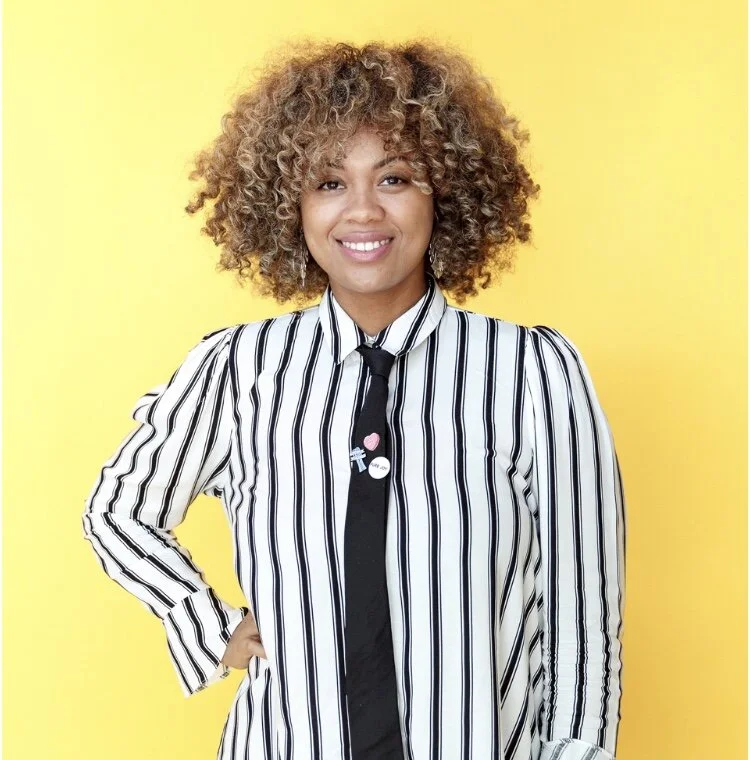
Today, we’re publishing an interview with Shauntavia Ward about her experience launching her own facial studio within the last six month. In this Q&A, Ward reminds us to invest in ourselves.

ABOUT SHAUNTAVIA WARD:
A nurse practitioner, licensed esthetician and business savvy new founder, Shauntavia Ward is trailblazing for skincare, entrepreneurship and women's empowerment. Shauntavia is the creative mind behind eleMINT Skin, a modern facial studio that aims to bridge the gap between beauty and wellness, while inspiring people to love the skin they're in. eleMINT is redefining the facial experience through services that are inclusive, accessible, affordable and impactful.
Describe the way your business and projects have grown and/or changed within the last three to five years.
What started as an idea on paper three years ago has grown into a disruptive skincare business with a chic physical space and cult clientele in-real-life. After years of dreaming, I put my plan into action and opened eleMINT, a modern facial studio six months ago. We've not only grown our clientele from zero, but we've diversified our revenue streams through events and strategic partnerships. It's been fast growth, but we're taking notes, making changes as necessary and excited about the future.
What's a money tip or trick that you've learned recently?
Everything can be negotiated—EVERYTHING. Each dollar made within your business has to positively impact your financial bottom line. Simple negotiations involving costs of supplies and shipping fees for example, can impact your profit margin. Small savings now give you the flexibility to choose to splurge later.
What advice or lesson would you share with someone who’s at the start of doing their own thing?
Get your personal finances in check. For your first few years in business, your personal credit is your business credit. Keep it in good standing, so when an opportunity knocks, you're ready.

Designed by Danni Wright
want more?
Join us at Money Moves and Mindsets this Saturday, December 7 from 10 AM to noon at the Capital One Café to hear Ward’s story. Thanks to Capital One’s commitment to supporting women in entrepreneurship and small business owners, this event is free and open to the public with RSVP.
Can’t make it? We highly suggest learning more about our biannual conference WORK, a one-day event that presents new ideas and approaches to creative and entrepreneurial work. Hosting 300 guests every summer and winter, this biannual, one-day event's panels, workshops and speaker sessions touch on personal and professional development, marketing, wellness, business management and entrepreneurship. ✨The next WORK conference will be held in January 2020 at the University of Texas at Austin’s Rowling Hall.

On Managing Day Jobs And Finding Inspiration: Dawn Okoro
To launch CHATROOM on November 18, filmmaker and artist B. B. Araya interviewed groundbreaking artist, Dawn Okoro. Keep reading for some takeaways from the talk.
This fall, BBATX (#bossbabesATX) is partnering with creative entrepreneur and visual artist, Mercy Emelike, to host CHATROOM, an art conversation series highlighting Black women and non-binary artists. This event series serves as an opportunity to provide space for artists to have a healthy dialogue with members in their community.
To launch the series on November 18, filmmaker and artist B. B. Araya interviewed groundbreaking artist, Dawn Okoro. Keep reading for some takeaways from the talk.

ABOUT THE ARTIST, DAWN OKORO:
Dawn Okoro is a Nigerian-American artist who settled down in Austin after receiving her bachelor’s degree from the University of Texas, and her law degree from Texas Southern University. Her passion to become an artist was inspired by her love of photography, design, and fashion illustration. Using acrylic, oil, and pencil, she incorporates photography, ideas, and collage from popular culture. Her artwork embodies space, movement, pattern, design, texture, and color; as well as lived experiences and self reflexivity. Okoro’s work has been featured in Forbes, Drawing Magazine, and The Austin Chronicle. Her work has also been shown at the Texas Biennial, New York University, Notre Dame University, Rice University Museum, George Washington Carver Museum, and MoCADA Museum in Brooklyn.

about the facilitator, B. B. Araya:
B.B. Araya is a Texas-based filmmaker. After interning for director Richard Linklater, she created and directed the short film series, We Are, which was was picked up for distribution by Issa Rae Productions. Her latest short film, Yirga, had its world premiere at SXSW 2019 and she’s currently penning her feature film debut.
HERE ARE THREE TAKEAWAYS FROM THEIR DISCUSSION:
“The greatest threat to my success is myself.” — DAWN OKORO
During this conversation, Okoro addressed many components of her life that influenced her personal journey through art. She opened up about her reluctant move back to Texas from New York, which resulted in her taking a five year pause from being an artist after facing rejection of her artwork. She confesses that “looking back [she] had unrealistic expectations and was impatient” when it came to settling back into her artistic groove.
“I don’t want to do this, I just want to do art.” — DAWN OKORO
Work-life balance was another important topic that was touched during this session with Okoro. When asked how her day job feeds into her creativity, she shares how she originally struggled with maintaining a job while also preparing for shows and building her art career. There was a period of time where she decided to solely focus on art, but eventually she found a manageable occupation that would support her artistry as well as providing a steady income.
“I wanted to create a space where the community I’m targeting feels like it’s a place where they belong.” — DAWN OKORO
Although Okoro was mainly exposed to American culture throughout her childhood, she traveled to Nigeria as an adult to learn more about her father’s side of the family. She expresses West African culture by incorporating patterns from fabrics she saw while visiting Nigeria, and also using Nigerian-American models dressed in traditional wardrobe and fabric. A prime example can be seen in her exhibition, Punk Noir, in which she features multimedia creative and friend, Moyo Oyeola. Okoro also draws inspiration from notable artists such as Barkley Hendricks, who creates vivid images of people of color against a solid background, and Andy Warhol who uses bright colors and bold aesthetics.
Want to attend THE NEXT CHATROOM?
Join us at the next discussion on December 2, feature mixed media artist, Deborah Roberts interviewed by writer and activist Virginia Cumberbatch.
Support The Things You Care About: A Look At BBATX's New Shop
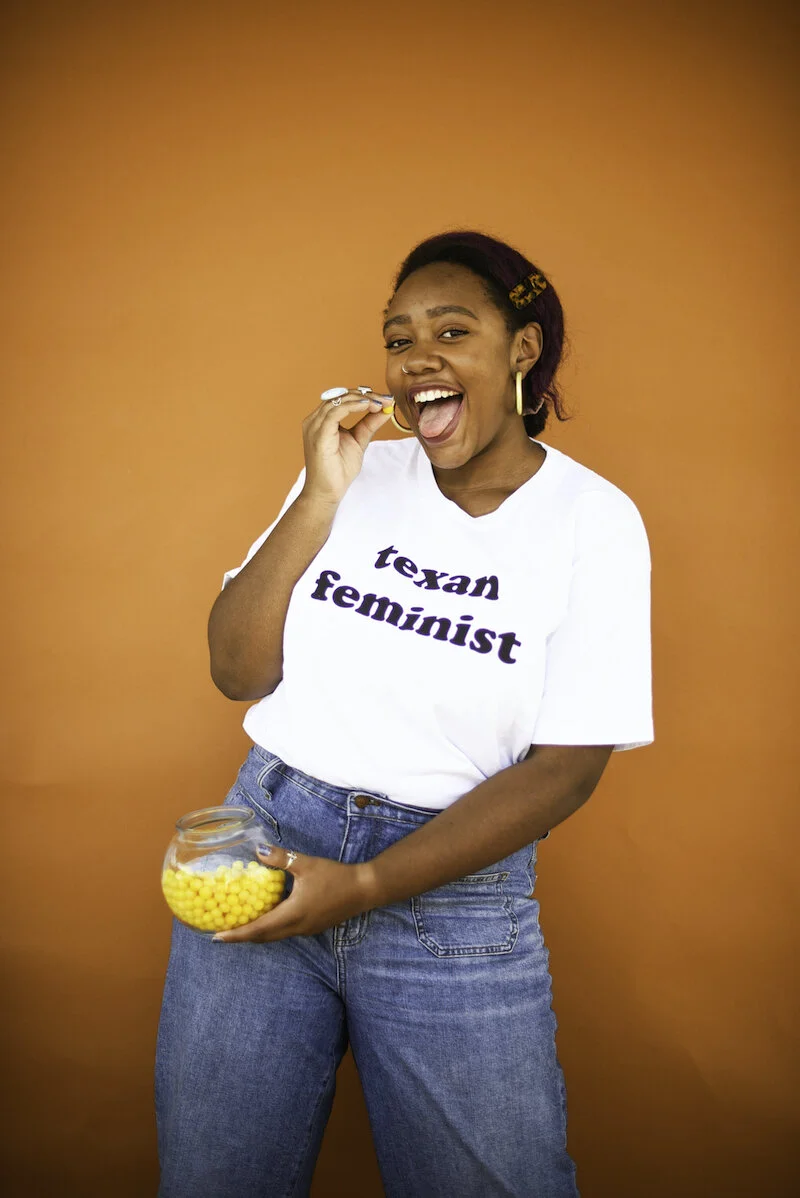
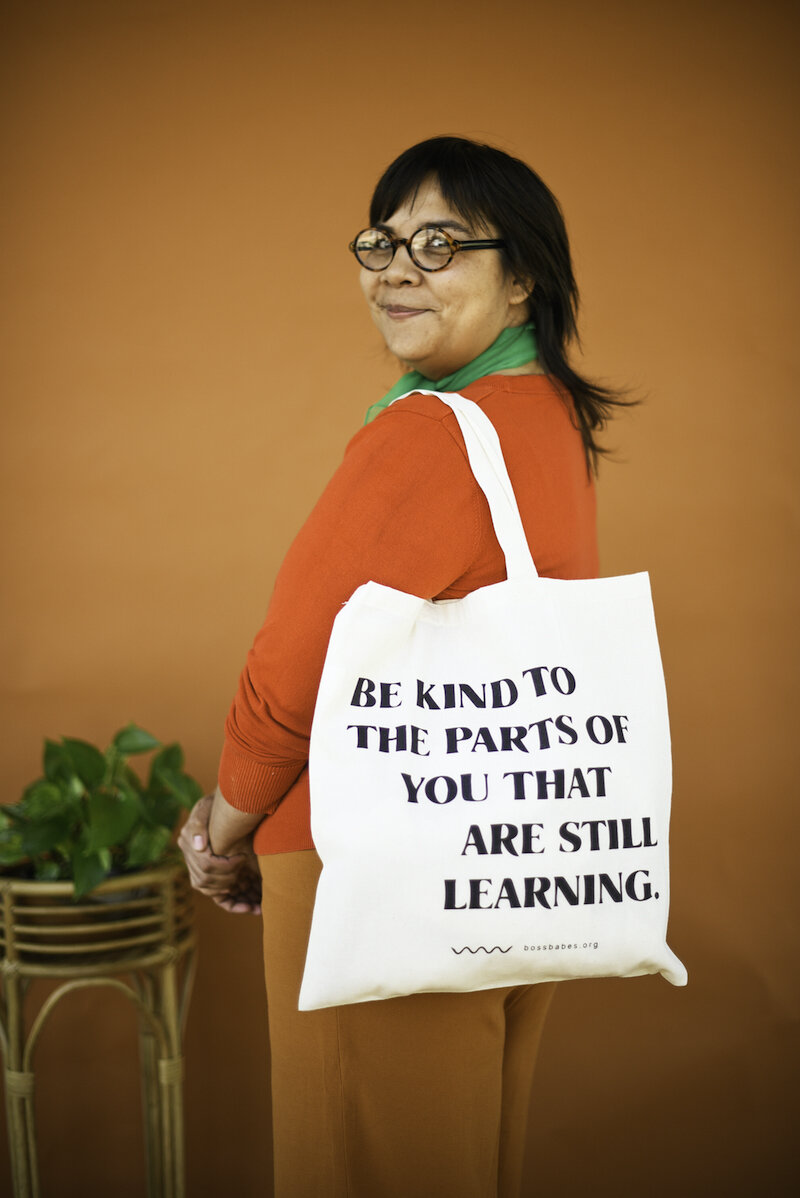
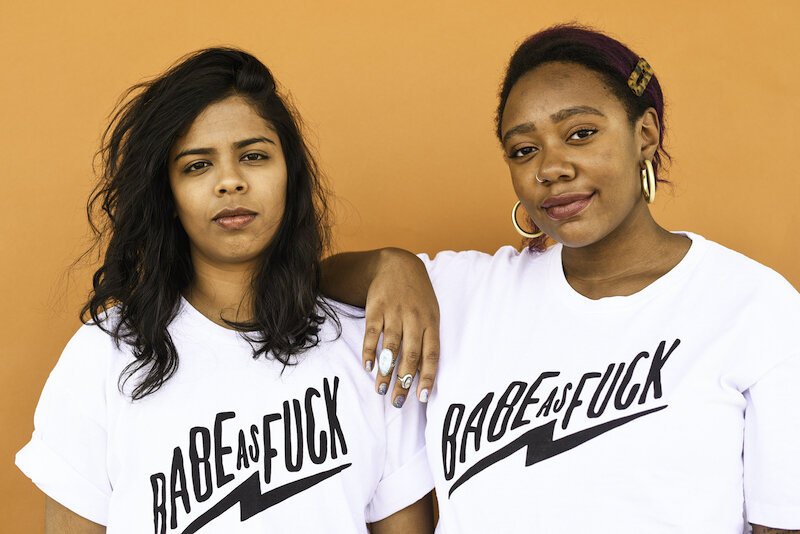
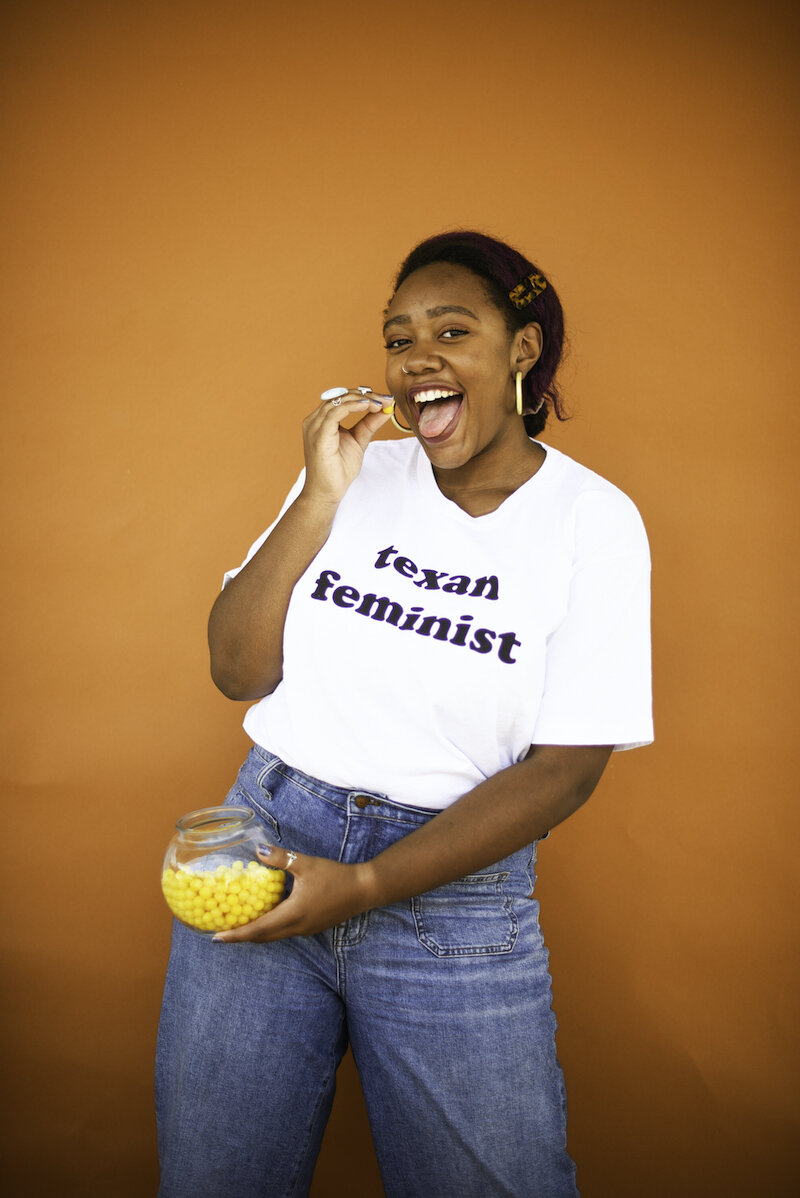
t’s time for our annual Giving Tuesday fundraiser, which means that from now until December 3 (aka Giving Tuesday), all of our tees, totes and merch are 20% off to raise funds for our programs. On top of launching the sale, today also marks the introduction of our ~ COMMUNITY STORE ~ section, featuring 43 women-owned creative businesses based in Austin, Texas.

It’s time for our annual Giving Tuesday fundraiser, which means that from now until December 3 (aka Giving Tuesday), all of our tees, totes and merch are 20% off to raise funds for our programs, like BABES FEST, craftHER Market and WORK.
On top of launching the sale, today also marks the introduction of our ~ COMMUNITY STORE ~ section, featuring 43 women-owned creative businesses based in Austin, Texas. Throughout the holiday season, you can stop by our online shop to support the people, places and things you care about. (Plus, as partners in this year’s fundraiser, all 43 stores are donating 10% of their sales on Giving Tuesday to BBATX!)
Continue reading for more info on this year’s Giving Tuesday fundraiser.
WHAT IS GIVING TUESDAY?
Giving Tuesday refers to the Tuesday after U.S. Thanksgiving in the United States. It is a movement to create an international day of charitable giving at the beginning of the Christmas and holiday season.
How can I support BBATX (#bossbabesATX) on Giving Tuesday?
To support our Giving Tuesday fundraiser, you can:
Buy something from our merch line between now and December 3 at 20% off at bossbabes.org/shop.
Support the women-owned businesses in our community section at bossbabes.org/shop.
Share a photo of yourself on social media in BBATX merch and encourage your friends to shop the sale and support our programs.
Donate directly to our programs at bossbabes.org/donate.
Keep on showing up to programs and events at BBATX in 2020. :)
Tell somebody why you believe that amplifying women and nonbinary creatives, entrepreneurs and leaders is important for our communities.
So, do your holiday shopping right and make our Giving Tuesday fundraiser count. You can find all of our merch, as well as our list of local businesses to support at bossbabes.org/shop.
Confessions of A Creative Entrepreneur: A Conversation With Sharon Mays
In this Q&A, creative entrepreneur and Baby Greens founder Sharon Mays shares some of the mindset shifts she has navigated throughout her experience self-funding, taking on investment and even filing for bankruptcy.

This week, we’re preparing for the launch of our Money Mindsets series, a three-part conversation with local Austin leaders at the Capital One Café downtown on November 21, December 7 and December 19 exploring money setbacks, leveling up and staying financially informed.
In anticipation for this Thursday’s first discussion with creative entrepreneur Sharon Mays, we’re publishing an interview with Mays about her experience launching, closing, then re-opening her healthy fast-food concept Baby Greens. In this Q&A, Mays shares some of the mindset shifts she has navigated throughout her experience self-funding, taking on investment and even filing for bankruptcy.

ABOUT SHARON:
Sharon Mays is the owner and founder of Baby Greens, one of the first fast food salad restaurant concepts. She also serves on the Austin/Travis County Sustainable Food Policy Board. Mays started her first company at 25 years old (a marketing agency called M City Marketing). She started Baby Greens in 2003 when she was 30; she opened 3 stores in the Austin and grew the company to a value of over $1MM, then she closed all of the stores in 2009. She had created Baby Greens to be a franchise but the operations were not meeting her vision for the company, so she closed to realign Baby Greens' mission, values and operational goals. Baby Greens reopened in 2016 and was one of the most highly anticipated restaurant openings in Austin that year. On top of being a community activist and realtor, she's also launched a consulting agency called Embark which focuses on helping entrepreneurs and soon-to-be-entrepreneurs open and/or expand their business.
Describe the way your business and projects have grown and/or changed within the last three to five years.
Reopening Baby Greens (BG) was very different the second time around because it's exponentially more expensive to start and run a restaurant in Austin right now. I was inexperienced the first time around so the fact that it was cheaper to open a restaurant made the situation more forgiving. All of my bills combined were less than my current rent and property taxes. So I'm fortunate to have come to this second time around with a much keener sense of business, because I think it just takes more skill, strength and resilience to succeed. I would say the biggest thing that has changed is me. I was so unaware of how risky it was to open a restaurant in the way I did the first time around, so I wasn't afraid because I didn't really appreciate what I could lose. But I also felt like such a small fish that no one was paying attention to what I was doing. There were things I wanted to do, but because I hadn't seen any other brand doing them I would chicken out. My first attorney told me, “You always come into my office asking my advice on an issue that you have already figured out. If you want to pay me to tell you that you're on the right track, that's fine. But you should save your money and trust yourself more. You are really good at this.”
Today I am less afraid because I have an extensive knowledge of my industry, but also because I fully own the fact that I'm still ahead of the curve. I own my power, completely and unapologetically. I can say without flinching that I am really, really good at my job. I don't think that the core of BG has changed. I would say the way we do things has changed. Before I would question if something was a "good idea" because I was doing things that other brands weren't and I wasn't sure that I knew enough to justify that innovation. I never question that anymore. Next year we're rolling out a new product line and adding new, more sustainable options to our product packaging. Both will be fairly unique to the Austin market as well as the fast, casual and quick-serve market (those are just fancy words for fast food). I've been working on them for awhile. They will show the evolution of the BG brand as well as reaffirm our innovative spirit. And most importantly, our customers are going to love them.
What's a money tip or trick that you've learned recently?
I took on investors when I relaunched BG. So I asked a VC friend [venture capital investor] if I could give him my pitch, so that he could give me feedback on my presentation. One of the things he told me was, “Raising money is one of the easiest parts of starting a business,” which sounded crazy to me. I felt like raising money was very difficult. But in the end he was right—if you don't go to a bank.
When you are starting something new, what you are asking/needing people to do is to invest in you. People don't invest in businesses, they invest in people. Except banks. Banks invest in businesses. So when you are starting out, you need someone to see your vision and hear your passion and buy into your story. A bank will not do that for you. I also learned that having more money means you will spend more money, but it does not mean you will have more success. I opened BG on a shoestring budget. I invested money in customer-facing things so that we looked legit. Customers didn't know that inside we had an old school cash register and hand-written tickets and second-hand equipment. That didn't stop us from having lines out into the street every day at noon and being voted “Best Salad and Dressing” in Austin four years in a row. When I reopened BG, we got a fancy POS system and shiny new equipment and all kinds of bells and whistles. And it didn't make us any more profitable than we were before. It's definitely nice to have nice things and I want my staff to have what they need to be successful. But on days when we have technical issues and I'm on hold with Tech Support, I miss that old $150 register. It never made me yell, "Speak to Customer Support," into the phone over and over again.
What advice or lesson would you share with someone who’s at the start of doing their own thing?
Reduce your personal expenses as much as you can when you before you launch your business. I lived in a two-bedroom apartment when I first opened BG. I moved in with my best friend after the first year. That move helped me save money, and it also meant I had someone to help entertain my dog while I was working crazy hours. (And someone to ask my how my day was when I got home from work.) I also paid off all my credit cards. Cutting my living expenses in half took a lot of pressure off, because it takes awhile to start seeing any money when you start your own thing. Even if it's a side hustle. It's going to take some time to start seeing any real money. I cut back on going out and eating out and buying things that I wanted more than I needed. It bummed me out at first, but as the saying goes: "If you want something you've never had, you have to be willing to do something you've never done." Or in this case, do without something you've never done without before. Stay at home. Work on your plan. Read books and blogs, listen to podcasts, watch vlogs, go out and network. Instead of spending money, spend time educating yourself
Also—be resilient. There will be days that you will question your decision. You will lose faith. You will talk yourself into giving up. It's the entrepreneurial emotional roller coaster. Making it out to the other side—to your launch—is the pound of flesh you pay to become an entrepreneur. That first leap is the scariest one, but you absolutely can do it.

Design by Danni Wright
want more?
Join us at Confessions of A Creative Entrepreneur this Thursday, November 21 from 6:30 to 8:30 at the Capital One Café to hear Mays’ story. Thanks to Capital One’s commitment to supporting women in entrepreneurship and small business owners, this event is free and open to the public with RSVP.
Can’t make it? We highly suggest learning more about our biannual conference WORK, a one-day event that presents new ideas and approaches to creative and entrepreneurial work. Hosting 300 guests every summer and winter, this biannual, one-day event's panels, workshops and speaker sessions touch on personal and professional development, marketing, wellness, business management and entrepreneurship. ✨The next WORK conference will be held in January 2020 at the University of Texas at Austin’s Rowling Hall.
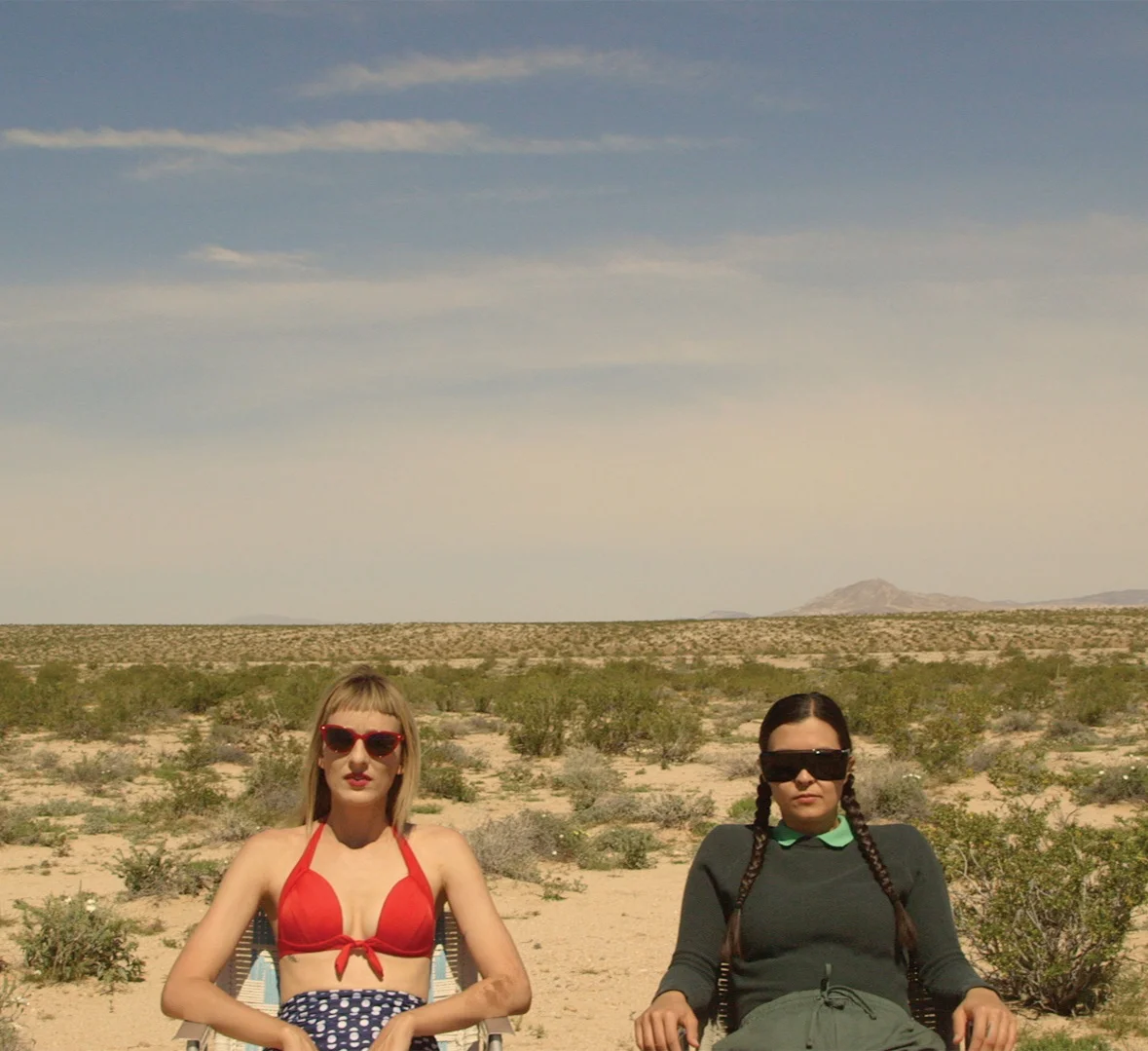
Meet the Dynamic Female Filmmaking Duo Behind Award-Winning Indie Film 'The Planters'
In this interview, Margeaux talks to Alexandra Kotcheff and Hannah Leder, the two women filmmakers that wrote, directed, crewed and starred in the award-winning indie film The Planters.


It might not be known on a worldwide scale quite yet, but filmmakers Alexandra Kotcheff and Hannah Leder are powerful forces to be reckoned with. The filmmaking pair directed, wrote and starred in their recent film The Planters (which swept the awards at this year’s Austin Film Festival).
The film itself is a dark comedy centered around Martha Plant, an air conditioner salesperson who lives a solitary existence planting buried treasure in the desert when she takes in and forms an unlikely friendship with Sadi— and all of her multiple personalities. Recently, Kotcheff and Leder were asked, “What changes when a woman sits in the directors chair?” And having had two directors in the case of The Planters, they answered: “We want to live in a world where people from all backgrounds, all genders and all identities are able to freely share and express their art. Every time a woman sits in the director’s chair, we get one step closer to a more honest representation of the society and culture in which we live.”
We were proud to be a partner and support a few of The Planters screenings the Austin Film Festival—and we were lucky enough to interview the duo about the film, their history working together and their creative insight.
This Q&A was conducted by BBATX communications assistant Margeaux Labat and is answered by Kotcheff and Leder as a pair.
You two single-handedly wrote, directed, starred in , and crewed this film, and were pretty much in charge of all aspects of the film’s production. was taking on the feat that was making the planters all by yourselves a deliberate choice? or something that just happened to be the way things turned out?
Making The Planters without an on-set crew was always how we intended to shoot. It was a wild-hair idea that also came with the peculiar and truly delusional belief that we could shoot the entire film in six weeks. We ended up clocking a total of 127 shooting days.
You two met when you were 8 years old, and made your first film together when you were only 12 years old! would you mind describing your early collaborative film projects together?
Our first film was about a suicidal pre-teen who was grieving the recent death of her parents… not unlike Alexandra’s character in The Planters. It was all parts emo. The next short was about a very intoxicated fortune teller. Though only one was intended to be funny, both are a riot and star Alexandra.
What was the most challenging aspect of making the planters?
It was a test of endurance we hadn’t anticipated. We signed up for a six-week sprint and ended up doing a two-year marathon.
If you could, what advice (or warnings) would you give yourselves before making the film?
Despite how you’re feeling right now (exhausted, over-heated, like you want to give up, etc.), there will come a time when you would do anything just to go back to experience the pure joy of being able to create with your best friend all alone in the desert again.
Can you tell us anything about your next film project, Peachville?
It’s a dark comedy about a bipolar Korean mother who takes her adult care-taking daughter to the tiny, quirky town of Peachville to open a nail salon. When a mining company threatens to take over, the mother-daughter team become integral in the fight to save the town. Peachville was a finalist for the 2016 Sundance Institute Screenwriters Lab.
What advice would you give to aspiring women filmmakers that wish to make films with perhaps a limited crew, training or resources?
For better or worse, we live in a time where access to all kinds of information is just click away. Use this and see where you can fill in the pieces yourself. We couldn’t afford to hire an editor so Hannah had a couple hours with an editor to pick his brain about Avid and then got online and taught herself the rest. Also, find people you admire and want to work with, and collaborate.
When and where else will audiences be able to see The Planters? Will it be in theaters anytime soon?
We are having our Los Angeles premiere this month at AFI Fest and we’re currently looking for the best distribution fit. In the meantime, you can keep tabs on our whereabouts on theplantersfilm.com and our joint Instagram account (@lederkotcheff).
Making Space For Us: Behind Our 2019 Residency
In this blog post, #BBATX 2019 committee member and board member Xochi Solis looks back on our 2019 residency and her contributions as the program’s lead curator.
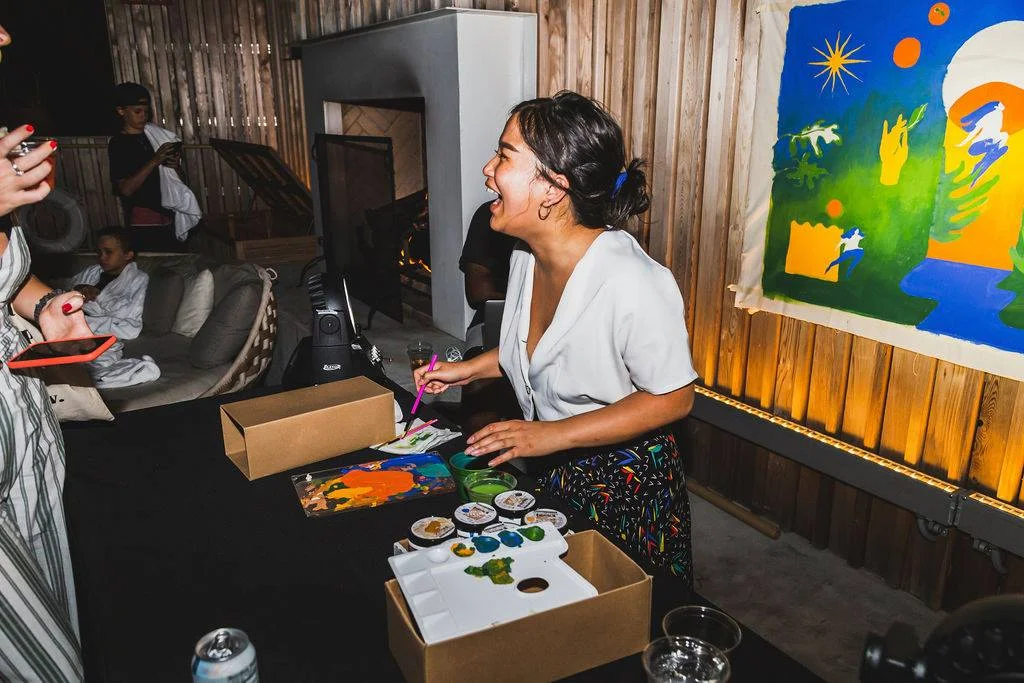
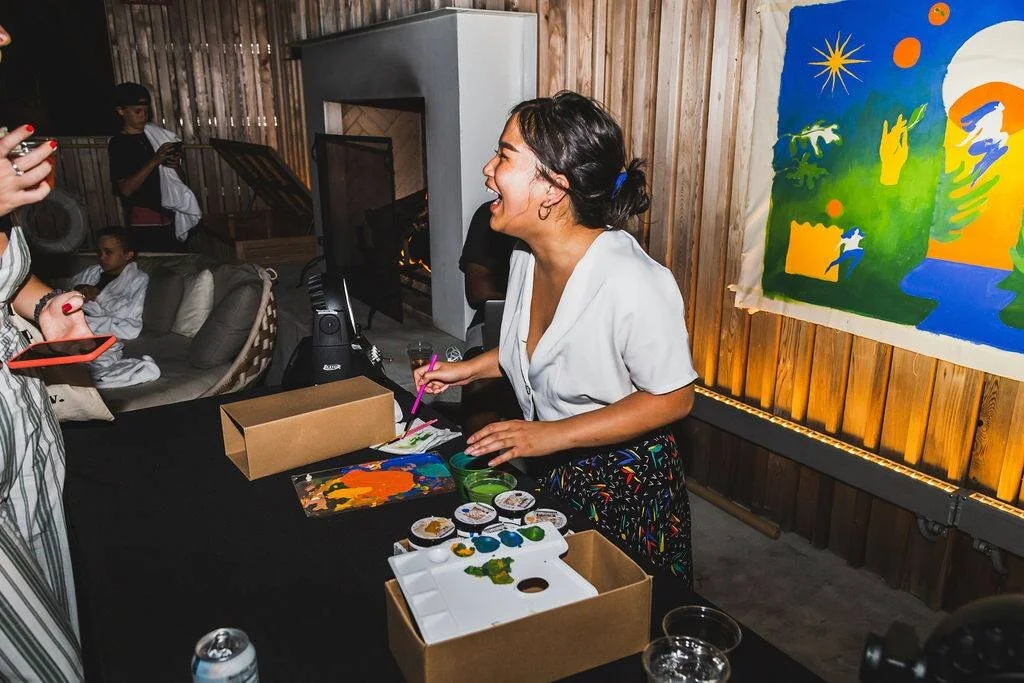
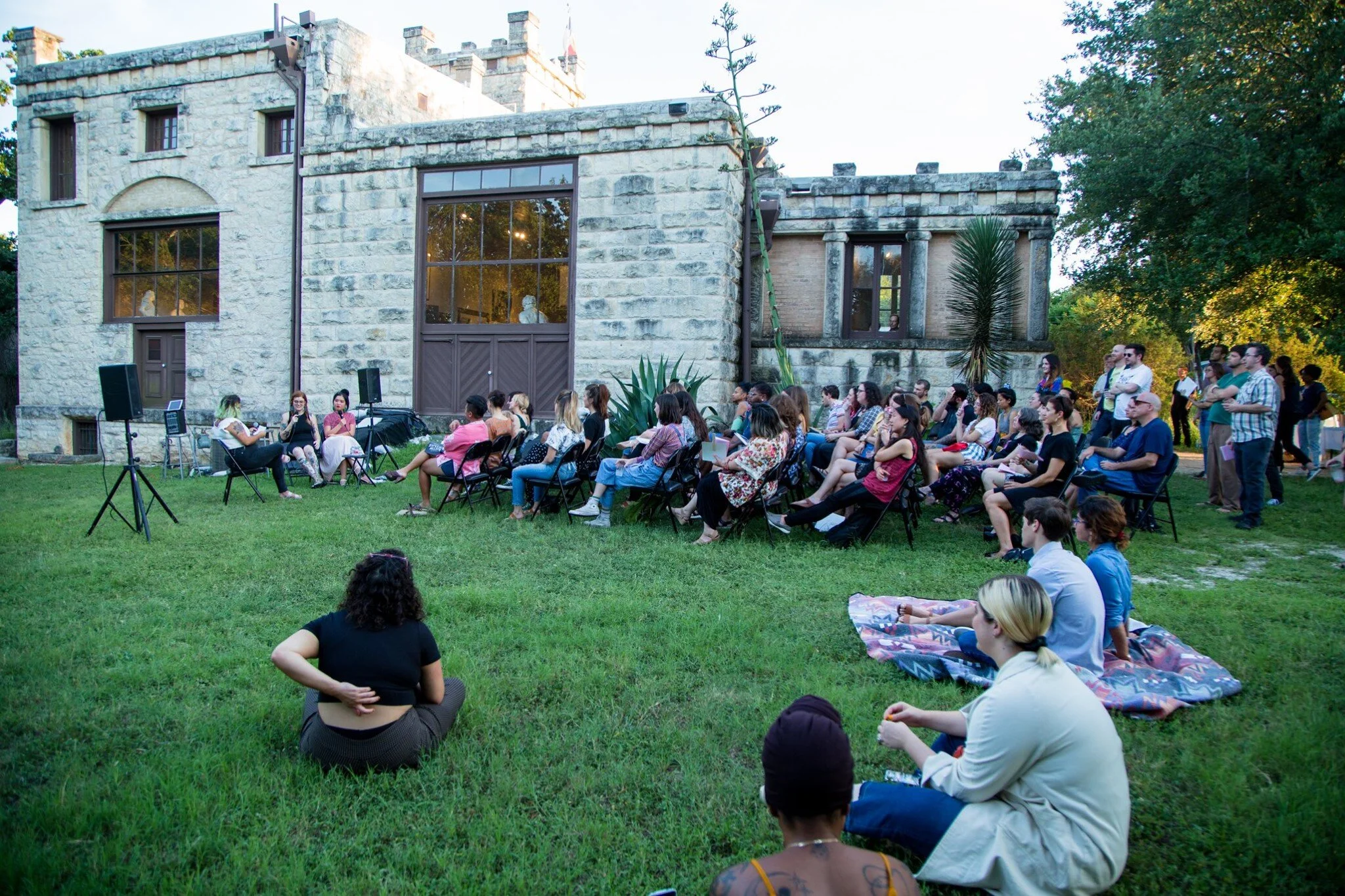
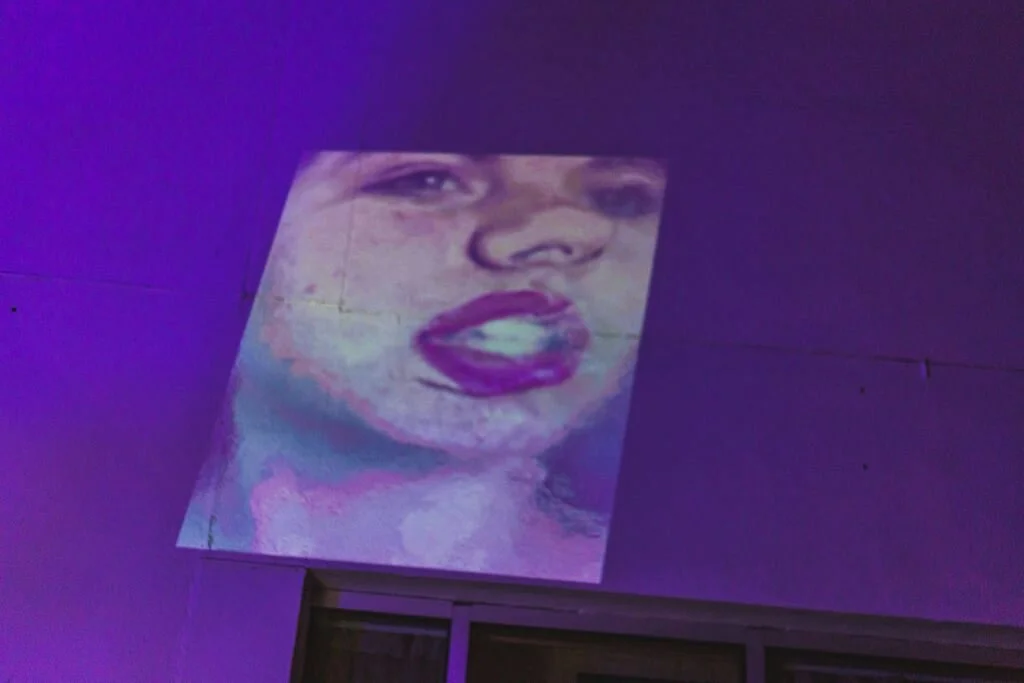
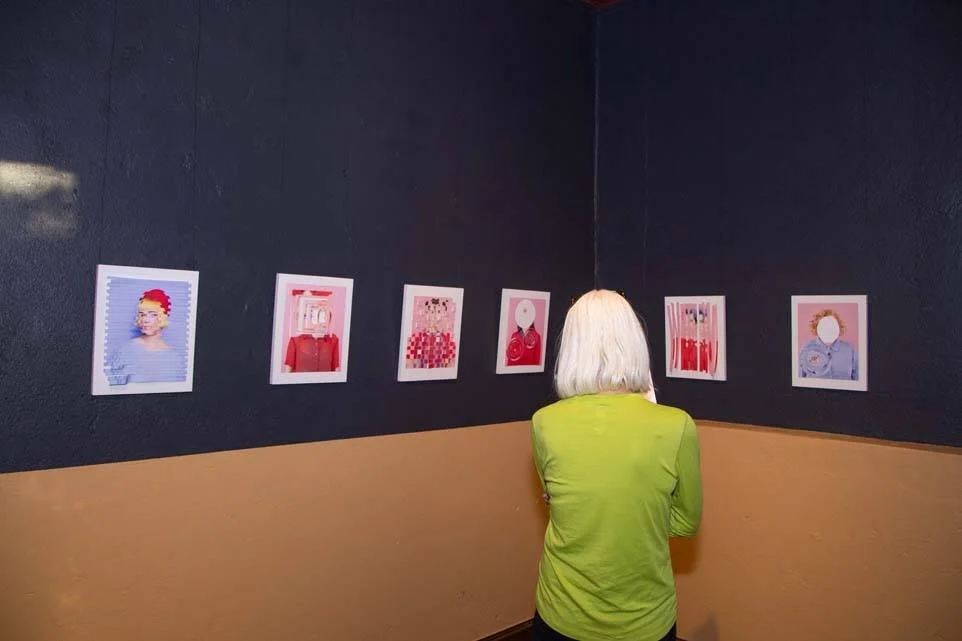
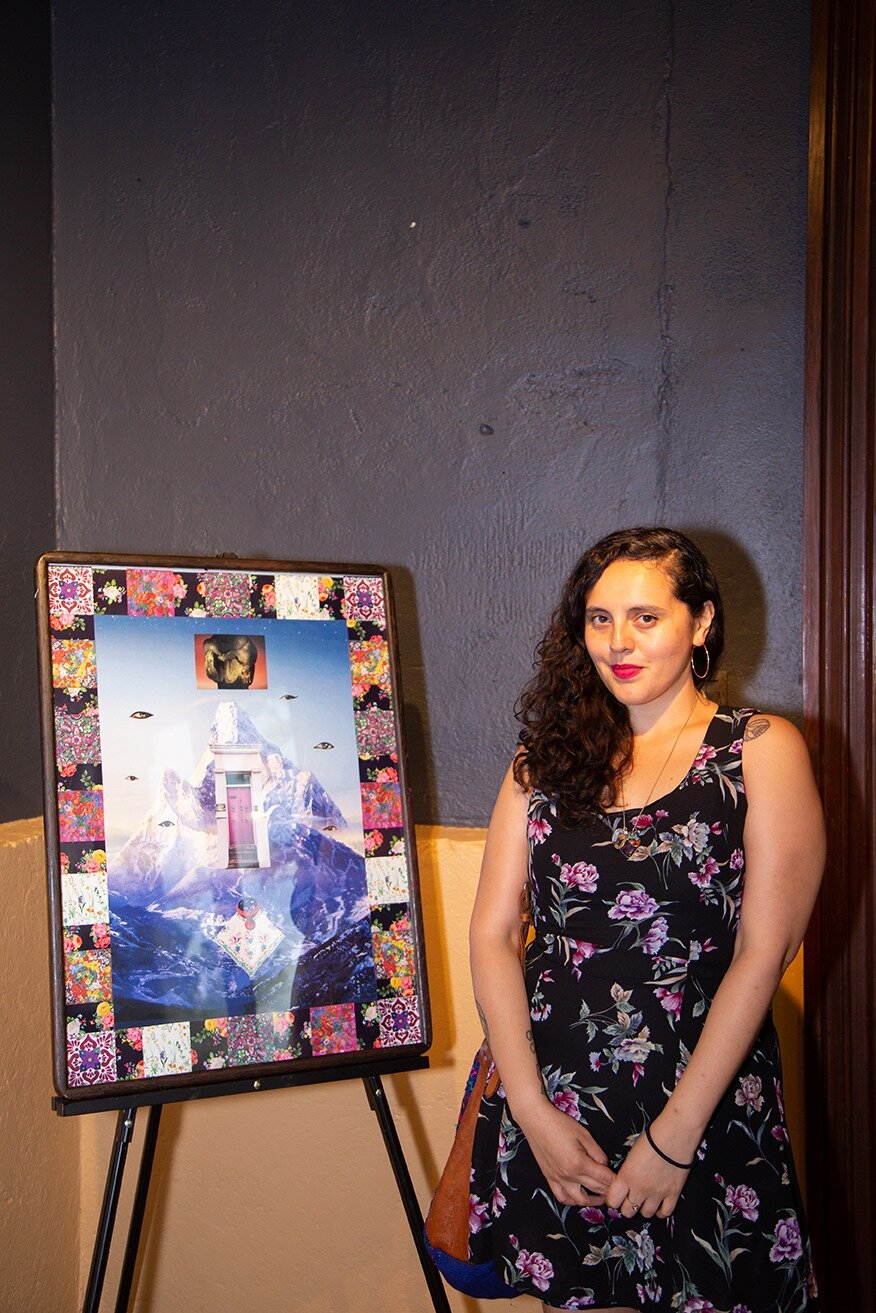
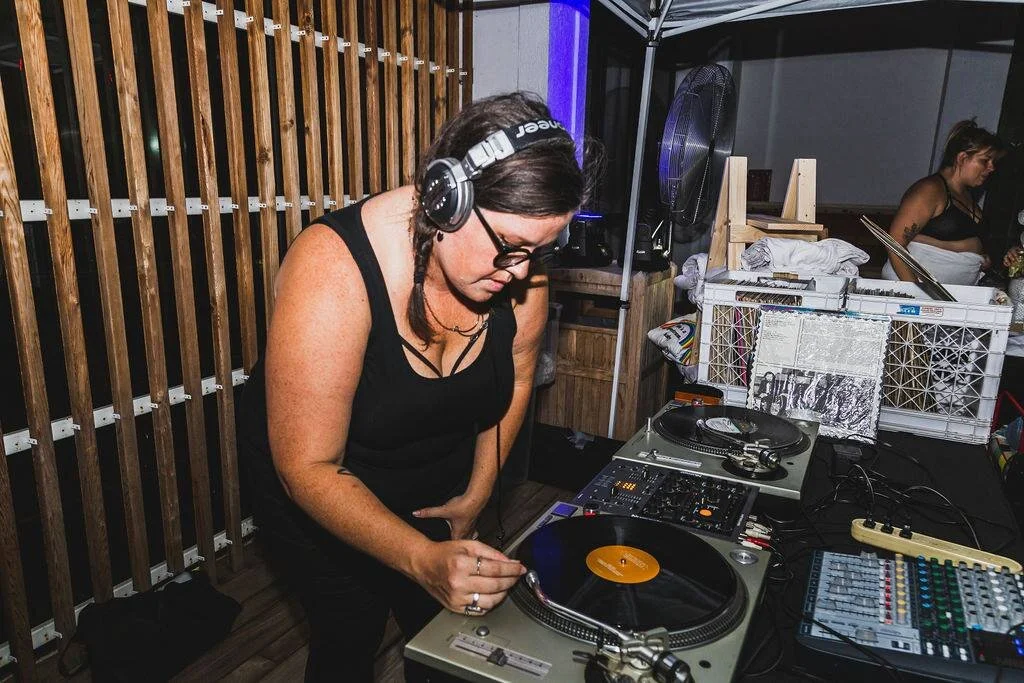
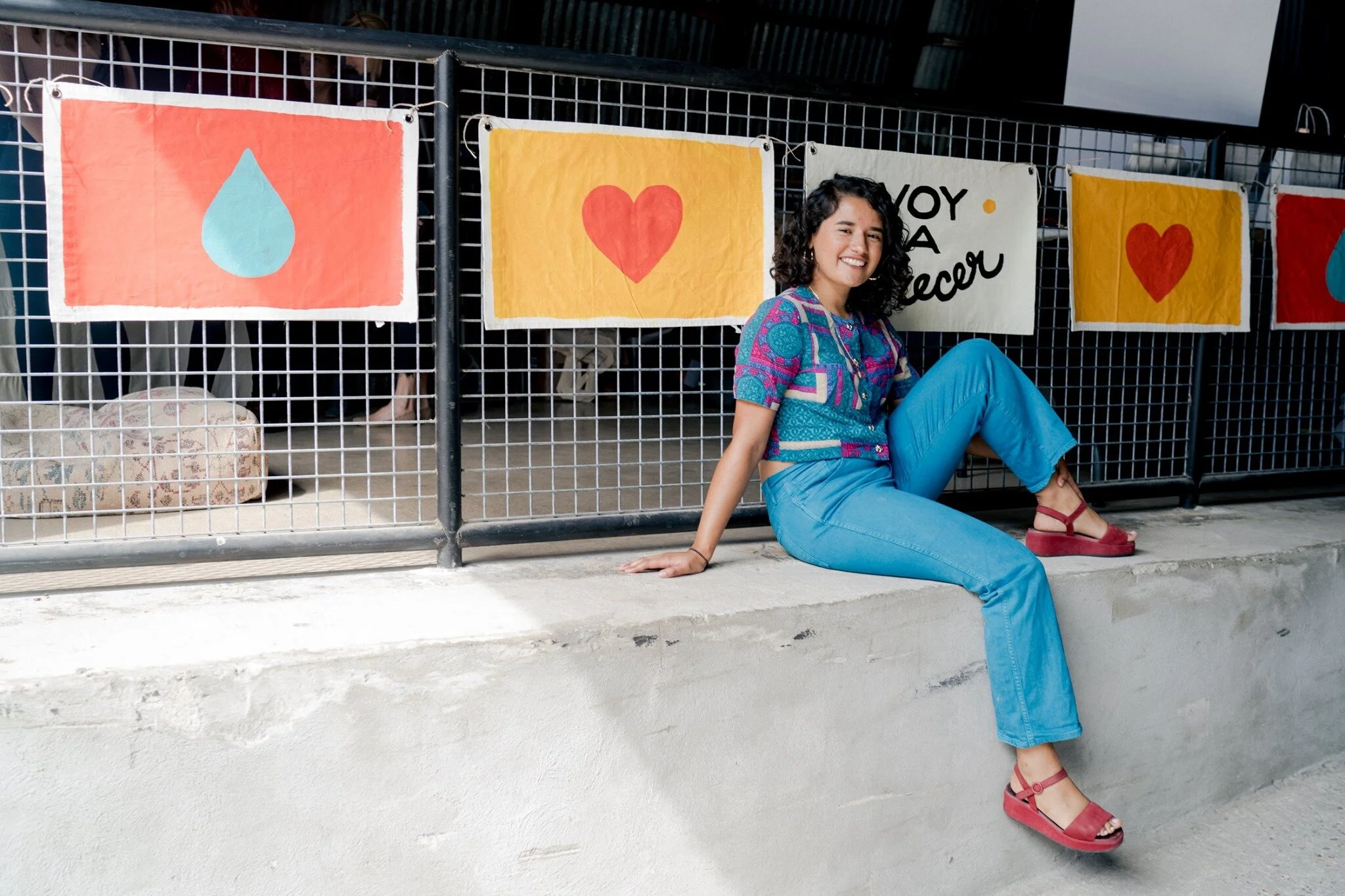
From March to September each year, BBATX curates a monthly residency highlighting the work of 10 to 15, Texas-based women and nonbinary visual and musical artists. Beyond the monthly features from March to September, resident artists work with the BBATX team and its collaborators to produce site-specific commissions and exhibitions within our programming. Throughout their residency year, artists are challenged to apply their skills and expertise towards community issues, too. And by design, each of the public programs, developed by our residents, also serve as a resource for their audience to learn about a range of artistic processes, approaches and sustainable methods.
~ In this blog post, #BBATX 2019 committee member and board member Xochi Solis looks back on our 2019 residency and her contributions as the program’s lead curator.

HOW IS THE RESIDENCY CURATED?
Actively seeking artists and artist duos who work visually—with sound, or some combination of both—The Residency program is curated internally by the #BBATX volunteer programming committee. Our committee steers the selection process focusing on Central Texas artists whose creative vision aligns with the values of our organization and who we believe are positioned for advancement in their field.
This year, as part of our dedication to create a more impactful year together, we began curating in February with an in-person studio visit. We met with resident artists to discuss their aspirations for the year and their practice as a whole. Some artists were shifting gears from one career into a new one—others wanted a more public space to showcase specific aspects of their craft. Each artist’s ambition was considered carefully and our committee members tracked their progress to make sure we were doing what we could to help share their work and process with our community. (Throughout the year the #BBATX blog has featured written interviews between committee members and resident artists that dive deeper into their practice. These blog posts remain as a permanent archive of our engagement with, and work done by, our chosen artists during their time with us.)
WHAT DID THE 2019 RESIDENCY LOOK LIKE?
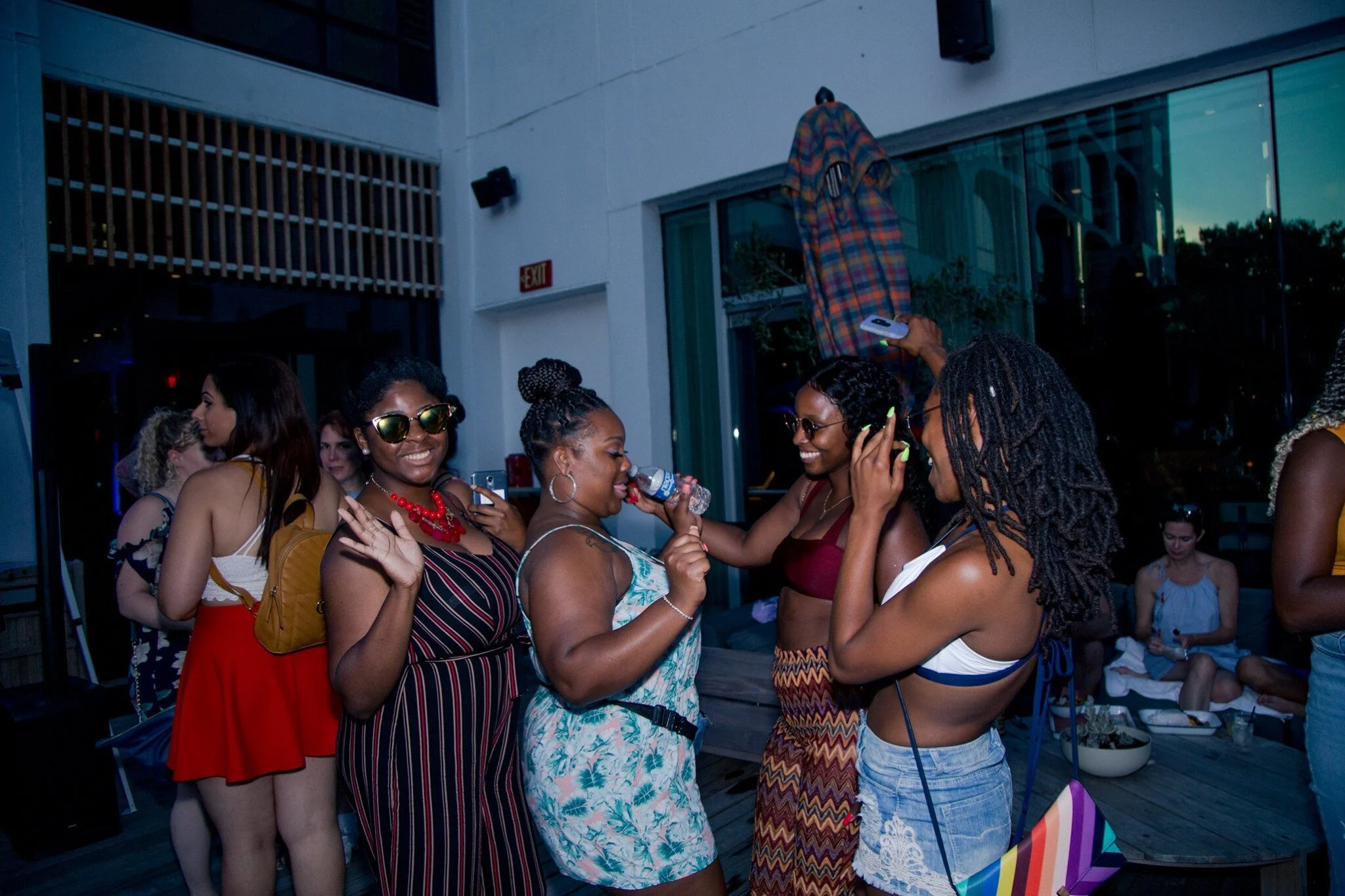
In 2019, More than 3000 people attended our monthly residency series, and we funded $8,000 in commissions and performances.
This was our second year ever producing The Residency, and it was the first time we were able to invest more time and money into helping each resident artist meet their annual goals. We continued what we started in 2018—a monthly party celebrating the work of women and nonbinary artists and DJs—by setting up each of our artists with featured performances at the LINE Hotel, but we also made a commitment to go further. We wanted to create more opportunities for financial gain and public exposure, while also giving our resident artists access to our vast and varied network.
So, this year, our approach was different. We kept each artist in the loop with monthly updates and opportunities to learn alongside us at any of our educational programs, like our quarterly community meet-ups, workshops and panel series. And our 2019 cohort were also given first dibs to artistic commissions for our shop, BABES FEST and craftHER Market. Funded by our organization, these commissions included the creation of soundtracks and mixes, unique and helpful way-finding signage, poster artwork, stage designs that beautifully hung behind panelists and performers alike and limited edition prints to celebrate milestones in the organization’s development. Beyond these paid opportunities, three of our artists also had the chance to debut and exhibit their work within Austin’s Elisabet Ney Museum.
On a personal level, it has been a joy to witness how much they have learned about themselves and the essential place they have within our ever-changing city. The development of The Residency program reflects the organization’s growth to better serve and connect women and nonbinary creatives in Austin, Texas and we look forward to nurturing the next year’s cohort in 2020.
MEET OUR 2019 ARTIST COHORT.
Working with #BBATX has given me the confidence to put myself out there professionally and begin to offer my DJ stylings to a much wider audience!
— Amanda Vaughn, DJ and researcher
Through the residency, I learned more about the women and nonbinary community here in Austin. Through craftHER Market, I discovered that there is a very supportive community for women and nonbinary makers’ work. I also learned about the historical Elisabet Ney Museum through the Meet Her Hands series. The residency has been a very interesting and educational experience of discovering what’s always been and what the future can hold.
— Tsz Kam, multidisciplinary studio artist
Being part of the DJ residency program with #BBATX truly helped me not only grow as an artist, but as a business this year. I am so grateful for the multiple opportunities they provided for me and the community they have fostered that comes out and supports these events! I grew my audience, played in venues I've always wanted to play in (the pool at the Line Hotel), pushed my boundaries with what I could do DJing-wise, met incredible people, and have some awesome collaborations in the works! Through this program I had and (will have) gotten booked out for multiple gigs (weddings, parties, openings). I also met incredible artists who I not only bought works from, but are also now my friends (Jinni J and Indigleaux).
— Cassandra Shankman AKA DJ CASS&RA, DJ and composer
I was so honored to participate in the #BBATX 2019 Residency I had heard about the organization’s events and had always wanted to be involved. My premier as a resident artist at the LINE Hotel was FANTASTIC, too. There's nothing more special than community dancing to my beats! It was another nod to my purpose to spread Deep House to Austin, Texas. DJing at BABES FEST was the cherry on top, and I'm so thankful that I recorded to share my set with the people. Thank you again for letting me be part of the team and I hope to contribute to future events!
— Shani Hebert, DJ and house music curator
The residency was a great experience for Double Trouble! We loved meeting the fellow residents and really appreciated the financial support and exposure that being residents gave us through the gigs we played. (This coming week we are playing the Austin Central Library Annual fundraiser, and we were discovered through being featured on the residency website!)
— Erin Gentry & Lynn Metcalf, DJ duo Double Trouble
I am beyond appreciative of having all the opportunities that have come from being part of the residency. I feel like I have gained more confidence in my abilities, and I have loved getting to know more local artists.
— Leika
Learn more about all of 14 artists in our 2019 Residency here.
GET INVOLVED WITH THE RESIDENCY.
The Residency 2020 will be announced on International Women’s Day (March 8, 2020). The monthly series will return in April 2020 at the LINE Hotel. Click here to sign up for email updates and notifications or you can always check back at bossbabes.org/residency.
Want to become a Residency partner? Head to bossbabes.org/partners and learn more.